Holding Memory
Nicola Cloete, University of the Witwatersrand
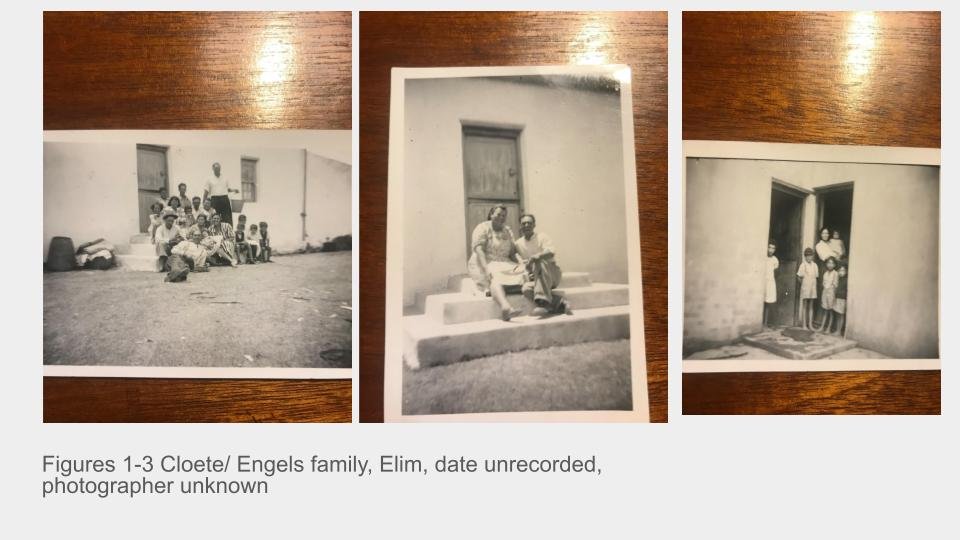
The photographs came out of a small tin box. I was interviewing my aunt, Carol Dunckers, about our family’s history, and as she handed them to me, one by one, she kept returning to the same place: Elim, the old mission station in the Western Cape where my father was born. For Carol, Elim was home. “It was where it started,” she would say, the first place she could trace our family back to, and the first place she felt she belonged. Elim is home to the only monument to be erected to commemorate the emancipation of slaves in South Africa. In 1838 several freed slaves moved to the settlement and many of their descendants remained for centuries. The photographs held no information about the photographer or the date leading to further ambiguity about the circumstances in which the images were taken but Carol remained adamant that these were images of her extended family – insisting on belonging despite the uncertainty. Hearing Carol’s stories of belonging to a place she had never lived in but only visited made me wonder about belonging in post-apartheid South Africa, and what histories of slavery have to do with it.
My answer, which I develop in my book Slavery and Cultural Production in Post-Apartheid South Africa: Holding Memory, is that belonging needs to be capacious and something descendant communities have to claim, in this instance through holding memory. By this I mean they carry, keep and bring to life a history the post-apartheid nation has largely left unacknowledged. Descendant communities do this through marking heritage sites, hosting commemorations, initiating exhibitions in museums and narrating their stories. And they do so against a background of post-apartheid cultural production: that is, the range of cultural productions (visual art, arts & heritage institutions, popular culture) produced in or about the end period of apartheid that includes the understanding that the structures of apartheid and their attendant legacies have not ended with the beginning of South Africa’s formal democracy.
I came up with this idea when considering what happens when histories of enslavement go unheld. Stereotypes and negative images have long pervaded the discourse of ‘Colouredness’, and debate over the term’s use in self-identification continues in South Africa. In 2019, researchers at Stellenbosch University published an article arguing that “Coloured” women had low cognitive function. It was retracted after criticism of its flawed methods and its reliance on apartheid racial categories. But the questions it raises stays with me. The apartheid state used “Coloured” to label people assumed to have “mixed” racial origins, and when the real history behind that identity (slavery, dispossession, violence) is not publicly held, the old categories and stereotypes fill the silence. Carol’s tin box is one small way of filling it differently.
To understand where those stereotypes come from, I look past apartheid’s classification to an older history. Like other scholars before me, I see ‘Colouredness’ as a complex identity shaped by slavery, genocide, rape and what colonial society perceived as ‘miscegenation’, long before apartheid gave it a legal label. Holding memory offers a different route to reclamation/recouperation. Instead of accepting the categories we were handed, we can trace ‘Colouredness’ back to the enslaved past and ask how people carry this inheritance today. In the book, I follow practices of holding memory to the places where it becomes visible: heritage sites and museums, the stories told inside them, the people who make or visit them, and the commemorations, festivals and news coverage around them.
Building on work in memory studies, I advance the field with holding memory as a way of understanding why slavery has become increasingly visible in post-apartheid public life: who holds this memory, how it is held in sites, stories and performances, and to what ends.
On the walking tours I joined, for example, slavery was something you moved through rather than something you read about. Walking the place and hearing its stories changed what it meant and challenged the versions of its history we had been told. Across my research, I found that ideas about slavery circulate widely in the Western Cape. Even though they are tied to ‘Colouredness’, they still reach beyond the ways this concept is commonly understood. Heritage-making, in other words, is not only about remembering. It is a way of answering who belongs, and on what grounds.
On the walking tours I joined, for example, slavery was something you moved through rather than something you read about. Walking the place and hearing its stories changed what it meant and challenged the versions of its history we had been told. Across my research, I found that ideas about slavery circulate widely in the Western Cape. Even though they are tied to ‘Colouredness’, they still reach beyond the ways this concept is commonly understood. Heritage-making, in other words, is not only about remembering. It is a way of answering who belongs, and on what grounds.
Nicola Cloete is