Becoming Intangible Cultural Heritage
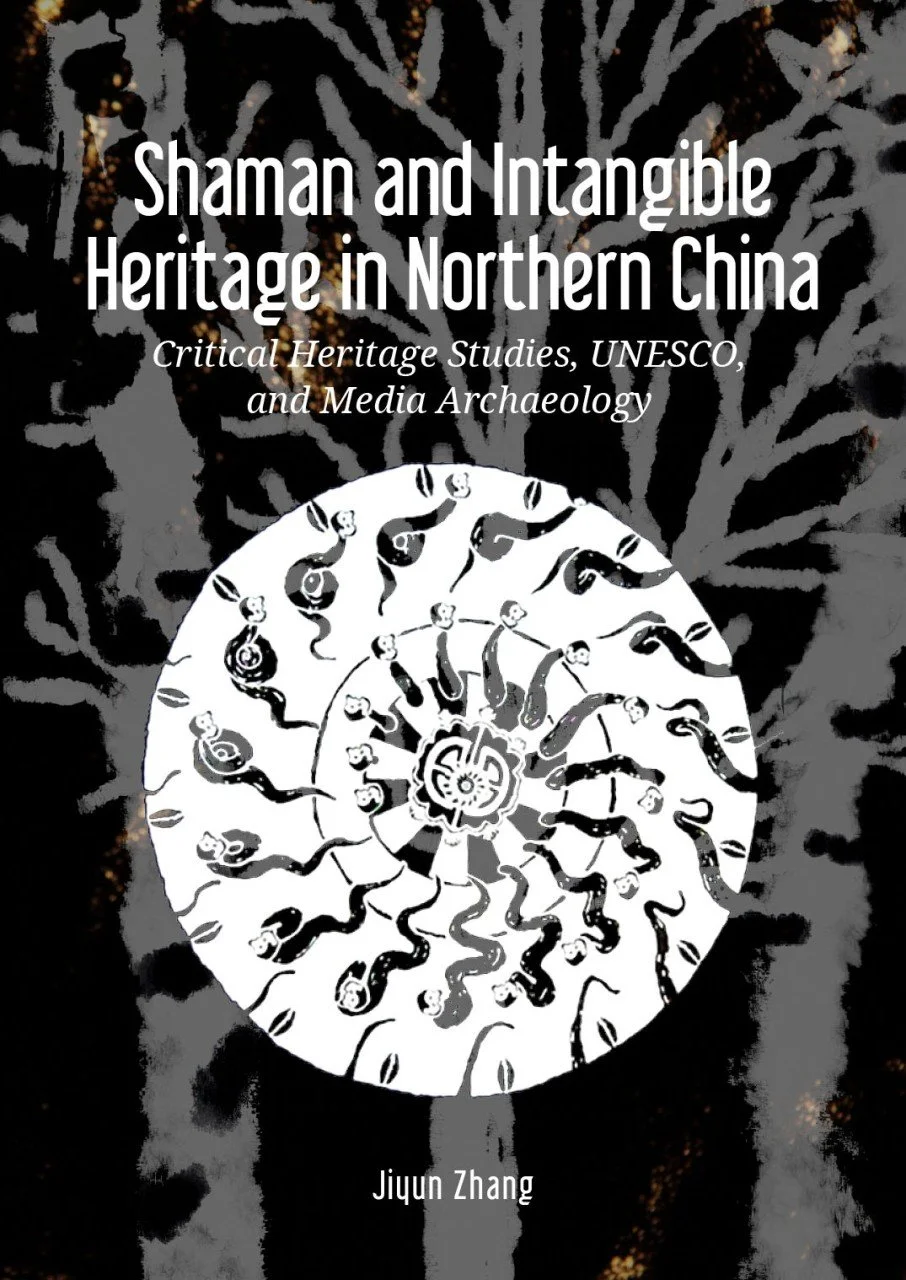
Cover image by Jiyun Zhang, featuring original drawings from Orochen Tale of Nisan Shaman (2022), inspired by Manchu ethnographer Yuguang Fu’s sketch (2009, 135) and Joseph Plateau’s First Series phenakistiscope (1833)
Jiyun Zhang, University of Antwerp
Shamanism, Media and the Translation of Cultural Difference
“Shamanism? We don’t have that anymore. The last Orochen shaman has passed away.” During a participatory animation filmmaking project (Zhang 2026a), a local cultural practitioner from Shibazhan—historically an imperial post station and now an Orochen ethnic township, and administrative unit designated for an ethnic minority community, near the China–Russia border—reflected on the changing status of shamanic practices. After a pause, she explained that a transmission ritual involving the late shaman’s descendant took place in 2017. Publicly announced as a blessing ritual (祈福仪式, qí fú yí shì), it did not, she emphasised, refer to “shamanism.”
The descendant, now officially recognised as a state-level intangible cultural heritage (ICH) bearer, is recognised for transmitting local folk songs, organising a folk-art group, hosting the River-Opening Festival (开江节, Kāi jiāng jié), revitalised since 2013, contributing to the development of an Orochen cultural park, an ethnic museum, and a traditional handicrafts training centre. This account raises questions about categories that can appear self-evident to outsiders. What happens when complex practices, relations, and knowledge, transmitted across generations are classified as ethnic culture, shamanism, tradition, or ICH? Who and what makes cultural differences recognisable as authentic, traditional, ethnic, living, or heritage? How do systems that claim to recognise cultural diversity simultaneously produce the categories through which cultural difference becomes intelligible?
My book, Shaman and Intangible Heritage in Northern China approaches these questions through the historical and contemporary mediation of cultural expressions associated with shamanism among ethnic groups. Rather than searching for an “original” or “authentic” tradition behind contemporary representations, it asks how cultural difference is continually transformed through changing ways of remembering, classifying, and representing the past.
Following Harrison’s (2013) engagement with shamanism and the ontological turn in heritage studies, the book takes shamanism as an analytical entry point for examining how cultural knowledge and difference are mediated. Bringing critical heritage studies into dialogue with media archaeology, it investigates how cultural practices become intelligible through shifting classifications, institutional frameworks, and media technologies.
Ethnographic museums, tourism sites, archives, audiovisual productions, and heritage frameworks are not neutral containers. They select, organise, and make certain aspects of cultural life visible while rendering others less visible.
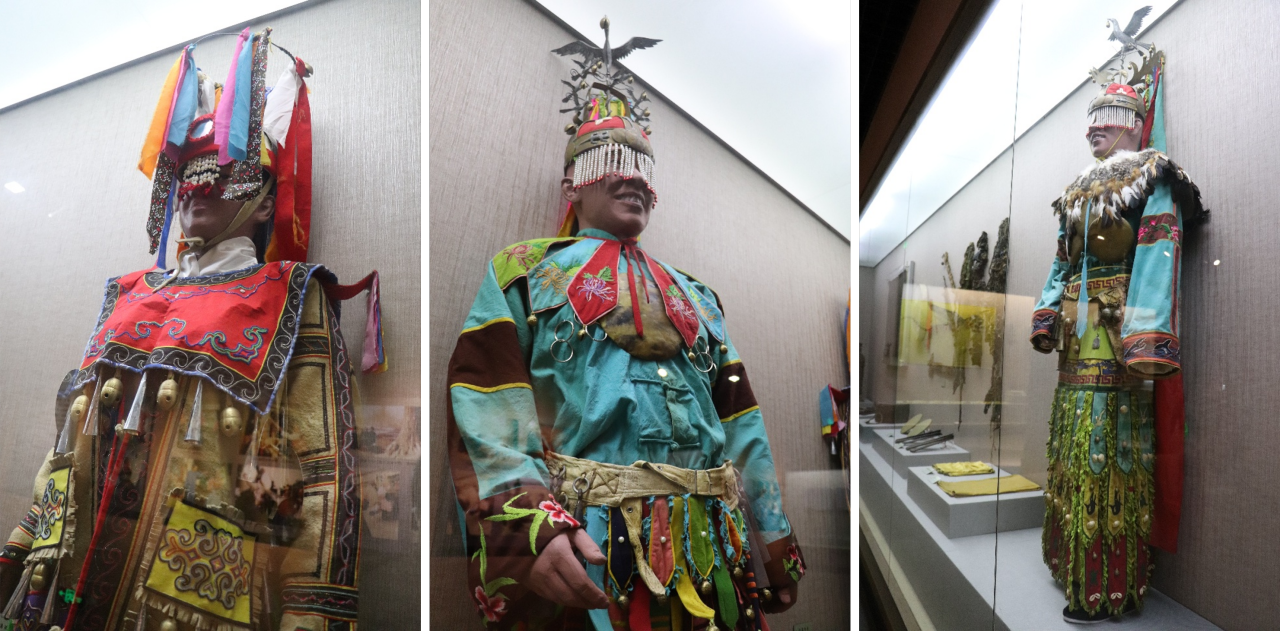
Depictions of shaman in the Museum of Yitong Autonomous County ( 伊通满族自治县博物馆, photography by Jiyun Zhang)
Classification is central to these processes and is inherently relational. Traditional is defined against modern. Ethnic implies a normative majority. Authentic becomes clearer when inauthentic forms are identified. Historically, shamanic practices have likewise been understood through distinctions between modern and traditional, civilised and barbarian, scientific and religious/superstitious, and central and peripheral. These categories are rarely stable descriptions of cultural difference but rather products of changing historical and institutional relationships.
Classification is not only textual, but materially and technologically mediated. Heritage is increasingly understood as a process through which cultural practices are selected, interpreted, and reconfigured. Yet it remains an open question whether the UNESCO 2003 Convention for the Safeguarding of Intangible Cultural Heritage and its infrastructures, designed to enhance ICH visibility and cultural diversity, while pursuing the ambitious goals of supporting SDGs, can avoid reproducing the distinctions between “us” and “them” through which cultural difference has historically been classified.
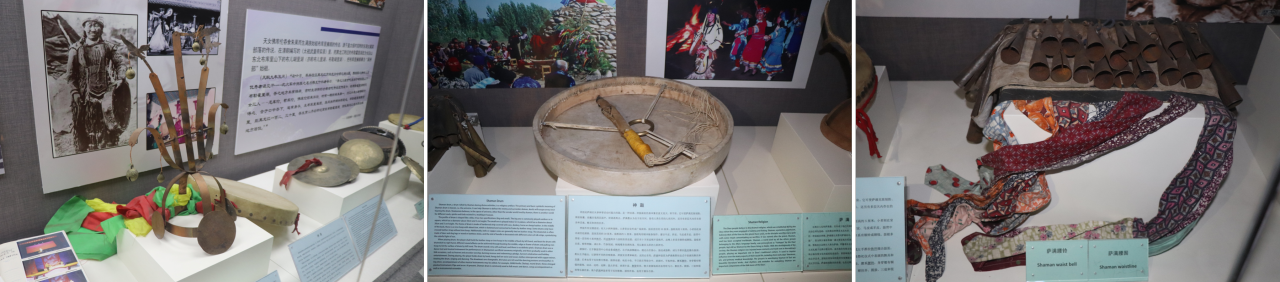
Shamanic idols in the Museum of Shamanic Culture in Changchun University (长春大学萨满文化博物馆, photography by Jiyun Zhang)
Smoke, light, shadows, sound, images, and motion—once central to shamanic rituals, religious teaching, and popular spectacles like market funfairs (Wynants 2026)—remain fundamental to contemporary sensory and performative mediation. Shadow puppetry, museum labels, ethnographic photographs, community films, video archives, digital platforms and nomination dossiers belong to different technological and institutional contexts. Yet each participates in rendering cultural forms and distinctions knowable and governable. Media archaeology reveals how classification is enacted through institutions, technologies, and representational practices (Elsaesser 2016, Parikka 2023), enriching critical heritage studies by highlighting the material conditions through which cultural knowledge is produced and circulated.
These processes are particularly visible in the ICH nomination videos submitted under the 2003 Convention. As a contemporary node of a much longer history of mediation, these videos are not simply documentary evidence illustrating traditions, but public-facing narratives that render cultural practices legible to an international heritage system. Institutional expectations and evaluation processes influence how countries and “communities, groups and individuals concerned” (CGIs, Jacobs 2024; UNESCO 2024) construct and curate ICH through framing, editing, narration, and selection. This, in turn, shapes how CGIs and their practices become publicly legible within global heritage discourse (Zhang 2026b, Zhang et al. 2025). When local practices enter an international heritage framework, what happens to their particularities and complexities?
For the Orochen and other minority CGIs in China, ICH recognition brings about public visibility and institutional support alongside processes of categorisation and translation. Beyond visibility itself, the challenge lies in understanding under what conditions, through whose participation, and in which forms recognition becomes possible.
This also unsettles “authenticity.” If every encounter with the past is mediated, and representations are continually constructed through selection and interpretation, what happens to the idea of “authenticity”? Changes in culture mediated through museums, tourism, heritage policies, and audiovisual media may signify less a loss of authenticity than ways CGIs negotiate changing political, economic, and social circumstances.
As digital media, immersive technologies, and generative AI increasingly participate in the production and circulation of cultural memory, anxiety surrounding “authenticity” become more pressing. Rather than asking whether new technologies make heritage more or less authentic, the beginning of a response lies in asking who defines authenticity, through which categories, and how particular versions of pasts, identities, and cultural relationships become perceptible and authoritative. How might these constructions shape possible futures? How might we recognise and make visible our own participation in these processes? The ways we represent culture is also part of how we shape its future.
References
Elsaesser, Thomas. 2016. Film History as Media Archaeology: Tracking Digital Cinema. Amsterdam: Amsterdam University Press.
Fu, Yuguang G. 2009. 萨满艺术论 (Shamanistic Art). Beijing: Academy Press.
Harrison, Rodney. 2013. Heritage: Critical Approaches. London: Routledge.
Jacobs, Marc. 2024. How and why the SDGs entered the paradigm of safeguarding intangible heritage: the “Sixth Chapter”. In Intangible Cultural Heritage and Sustainable Development: Inside a UNESCO Convention, edited by Chiara. Bortolotto and Skounti, A., pp. 55–70. London: Routledge.
Parikka, Jussi. 2023. Operational Images: From the Visual to the Invisual. Minneapolis: University of Minnesota Press.
UNESCO. 2024. Basic Texts of the 2003 Convention for the Safeguarding of the Intangible Cultural Heritage 2024 Edition. Paris: UNESCO.
Wynants, Nele. 2026. Performing Science, Mediating Knowledge: Introduction. In Performing Science, Mediating Knowledge, edited by Nele Wynants and Andersen, E., pp.9-25. Turnhout: Brepols.
Zhang, Jiyun. 2026a. Digital media and safeguarding intangible cultural heritage of minority groups in China: a case study of animated short films Orochen Tale of Nisan Shaman and Orochen Creation Story. In Engaging communities in cultural heritage, edited by Tuuli Lähdesmäki, Turunen, J., Terian, A, and Garcia-Bardidia, R., pp. 161-180, London: Routledge.
Zhang, Jiyun. 2026b. Framing and Reframing the Participation of the Communities, Groups, and Individuals Concerned: A Media Archaeological Analysis of Nomination Videos of the 2003 Convention Submitted by China. Heritage & Society 19 (2): 524–548.
Zhang, Jiyun., Sophie Elpers, Shikoh Shiraiwa, Ahmet Aral, and Marc Jacobs. 2025. Towards Ecomedia Objects and Archives of Cultural Continuity and Transformation: Sustainable Development in ICH Nomination Videos from China, Germany, Japan, and Türkiye. In UNESCO Digital Library: MONDIACULT 2025, pp. 1–21. UNESCO World Conference on Cultural Policies and Sustainable Development-Mondiacult 2025.
Dr. Jiyun Zhang is an independent animation filmmaker and cultural heritage scholar affiliated with the faculty of Design Sciences at the University of Antwerp. Her interdisciplinary approach connects critical heritage studies with media archaeology, focusing on the operational audiovisual archive of the 2003 Convention and participatory animation filmmaking.