The ACHS Early Career Researchers Network aims to connect researchers and practitioners, in the early stages of their careers, who are interested in the interdisciplinary field of critical heritage studies. The network is predominantly aimed at postgraduate research students, postdoctoral researchers and those starting out in professional heritage practice, but is open to anyone who self-identifies as "early career". The network shares news, opportunities and resources, with a particular emphasis on fostering international and interdisciplinary collaboration.
Within the ACHS, we work to:
Open up the structure of the ACHS to better support early career researchers
Communicate early career researchers' wishes and needs with the Executive Committee
Make ACHS conferences more informative and attractive to early career researchers
As a network, we work to:
Challenge, support and assist each other in developing successful and high quality research and professional practice
Encourage the active engagement of early career researchers with the wider ACHS community
Arrange events for early career researchers interested in critical heritage studies
Share ideas and information, particularly relevant to early career researchers
Take a look at our blog, find us on Twitter and Facebook or email us at ecr@criticalheritagestudies.org - and ask to be added to our mailing list!
The network coordinating team:
Andrea Berettera
Andrea Berettera is an Italian archaeologist and critical heritage researcher, currently pursuing a PhD in Analysis and Management of Cultural Heritage at IMT School for Advanced Studies Lucca. He holds a BA and an MA in Archaeology from the University of Padua, complemented by study and research periods at Université de Toulouse (France), University College London (UK), and the Centre for Critical Heritage Studies at the University of Gothenburg (Sweden).
His research sits at the intersection of Public Archaeology and Critical Heritage Studies, exploring the role of the past in contemporary society, with a particular interest in the ways archaeological heritage is interpreted, represented, and mobilised in public culture and political discourse. His doctoral project examines how archaeological heritage has been used in twenty-first-century Italy, investigating how narratives about the past contribute to the construction of identities, collective memory, and cultural values. More broadly, he is interested in the relationships between heritage, power, representation, and public engagement, and in the changing uses of the past in the modern and contemporary world.
Alongside his research, Andrea has experience in heritage communication, audience engagement, and the organisation of conferences, seminars, and public-facing initiatives that connect cultural institutions, professionals, and diverse audiences.
Andrea speaks Italian, English, and French.

Matteo Collina
Matteo Collina has a BA in Graphic Design and Visual Communication, and a MA in Cultural Heritage Photography. He is a technical and cave diver, a scuba instructor, and his main interest is underwater heritage. He has worked for five years as a Research Fellow studying survey methods for 3D reconstruction of underwater archeological sites, working on several European projects and 3D scanning shipwrecks all over the Mediterranean Sea. He has also been a Teaching Fellow for Cultural Heritage Photography and Scientific Photography.
Matteo's current PhD research at Te Herenga Waka - Victoria University of Wellington, New Zealand, focuses on raising awareness of underwater heritage through Virtual Reality experiences taking a multidisciplinary approach that involves museums, science, and art. He is focusing on the Fiordland region, and he is closely working with the Victoria University Coastal Ecology Lab on different research about black corals, sharks and sponges. In particular, he is interested in new storytelling approaches, and he is exploring the possibility of narration through the embodiment of the land concept.
Matteo speaks Italian, English and some Spanish.

Victoria Vargas Downing
Victoria Vargas-Downing is a Chilean art historian and heritage researcher based in the UK. She holds a BA in Fine Theory and History of Art from the University of Chile, a Curating Diploma (Universidad Adolfo Ibanez) an MA in Arts Management and Heritages studies and a PhD in Cultural Studies from Leeds University. Her research verse on the relationship between contemporary art and heritage from decolonial and feminist perspectives. She has participated in art and curatorial residences in Sao Paulo (Habeas Data by Curatoria Forense), Los Angeles CA (Otis College of Arts and Design), Vienna (Curator's Agenda By Block Frei) and Belgrade (What Could/Should Curating do). She is also chair of ‘Ventana Conference on decolonisation’ and Chair of the Latin American and Caribbean Chapter.

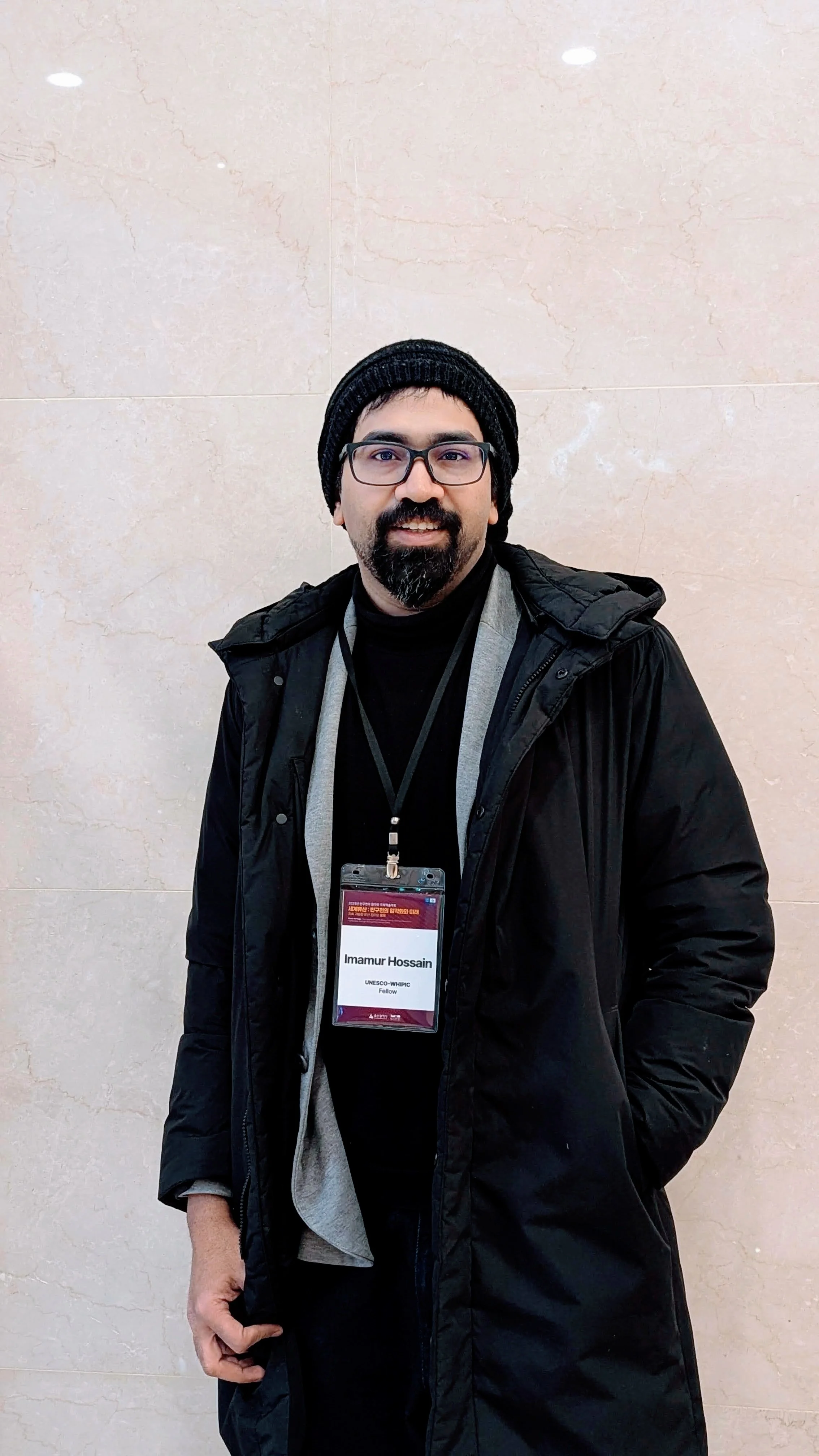
Imamur Hossain
Imamur Hossain is Assistant Professor of Architecture at Sonargaon University, Dhaka, and a critical heritage researcher trained in architecture and the built environment. His scholarship situates architectural heritage within critical heritage studies, examining how built form, institutional recognition, and digital mediation authorise particular narratives of place. Working from Bangladesh and the wider Global South, he approaches interpretation as a political practice through which community attachments are made visible, negotiated, or suppressed.
His work brings architectural reading to questions of heritage discourse, community agency, and mediation. Across nationally and internationally supported work in conservation planning, documentation, and digital interpretation, Imamur examines how heritage practice moves from fabric and representation toward the more difficult question of who can shape meaning. His augmented-reality work with marginalised and remote communities in Bangladesh forms part of a broader concern with the limits of access-driven heritage practice. As a 2025 UNESCO WHIPIC Fellow, he extended this concern to community narratives and site-based interpretation at World Heritage sites.
Imamur holds an MA in Heritage and Interpretation with distinction from the University of Leicester as a Commonwealth Scholar and a Bachelor of Architecture from BUET. He serves as managing editor of two open-access, double-blind peer-reviewed journals, the Journal of the Built Environment of the Global South and South Asian Cultural Studies, and coordinates the International Centre for Development and Environmental Studies at his university. He is also part of the coordinating team of the ACHS Early Career Researchers Network.
Boryana Ivanova
Boryana Ivanova holds an MA (Hons) in History from the University of Edinburgh, and is currently pursuing an MSt in Building History from the University of Cambridge. She specialises in architectural narratives and historical contexts, and is passionate about preserving heritage and enhancing the built environment.
She is currently conducting a work placement with Alan Baxter’s conservation team, working on several heritage sites across England. As well, she is a Young Advisor for Historic England, contributing to policy recommendations, research, and youth-centred discussions.
She is interested in post-crisis recovery and reconstruction of both tangible and intangible heritage and is conducting independent research on heritage as a tool for peace-building, resilience, and healing through community action and collective memory regeneration. Alongside this, her Master’s thesis at Cambridge examines post-WWII damaged churches in London and their transformation into memorial sites.

Yelyzaveta Nesterova
Yelyzaveta Nesterova is a heritage researcher who currently pursues PhD in Media, Culture and Heritage at the School of Arts and Cultures at Newcastle University (UK).
Her PhD project cuts across a number of disciplines – heritage studies, anthropology, archaeology, cultural geography, tourism studies, to name a few - and adopts new materialism-informed theories and approaches for studying a variety of routine, everyday interactions with archaeological heritage.
Yelyzaveta's case study focuses on funerary monuments located in Kaş, a seaside town in the Southern Türkiye, Antalya province. She experiments with non-representational methods and considers how they challenge and allow expanding the rhetoric of critical heritage studies with regard to individual and everyday values, as well as uses of heritage, beyond the currently existing limitations.
Since her early childhood, Yelyzaveta has been fond of all things archaeology and has rediscovered this passion through heritage and tourism studies during her bachelor’s, later continuing her academic training and completing a master’s in archaeology and history of art. Her interdisciplinary background, as much as life experiences themselves, have shaped her interest in exploring how and why people interact with archaeological heritage and what more-than-human world has to say about.
Yelyzaveta's research interests revolve around social values and uses of heritage, affect and emotion, post-qualitative and non-representational approaches to research, critical heritage studies and new materialism theory.
Her research is funded by the Arts and Humanities Research Council, Northern Bridge Consortium Doctoral Training Partnership.
She is also an Editorial Assistant for the Currents in Critical Heritage Studies platform (ACHS).
Yelyzaveta speaks English, Turkish, Ukrainian, and Russian.
Desmond Hok-Man Sham
Dr Desmond Hok-Man Sham is an Assistant Professor in Cultural and Creative Industries at the University of Nottingham. Desmond is a cultural studies and urban studies scholar specialising in cultural and creative industries and cultural heritage in the context of identity, diversity, and sustainability, with a research and teaching focus in East and Southeast Asia and the Sinophone world.
Desmond's research has three interrelated foci, namely: (a) the nuanced and interactive relationship between cultural heritage and other fields of cultural and creative industries in the context of cultural and social sustainability; (b) the politics and potential of cultural heritage, memoryscapes, museums, and the cultural and creative practices, in relation to identity, diversity, and decolonisation; and (c) postcolonial/decolonial studies.
He speaks English, Cantonese, and Mandarin.

Stanley Onyemechalu
Stanley Jachike Onyemechalu is a Nigerian Gates Cambridge Scholar and PhD Candidate in Archaeology at King’s College, University of Cambridge, UK. His research, which was recently awarded the Emslie Horniman Anthropological Scholarship Fund, explores the complex relationship between cultural heritage and the legacies of violent conflicts in the context of the Nigeria-Biafra war (1967-1970). He is the current Book Reviews Editor for the Archaeological Review from Cambridge (ARC) journal and has a Lectureship in Archaeology and Heritage Studies with the University of Nigeria.
His research interests cut across conflict heritage and legacies of violence, (Post-)Conflict and Memory, Critical Heritage Studies, Sustainable Cultural Heritage Management, Museum Studies, and Community Archaeology. He also has teaching/research experience and publications in these areas.
Stanley is fluent in the Igbo and English languages.

Ran Wei
Ran is a Lecturer at the School of Public Policy, The Chinese University of Hong Kong, Shenzhen. Ran’s research focuses on heritage conservation planning and heritage-led urban regeneration. Her current work examines how the decision-making and implementation process of China’s urban projects are shaped by the negotiation and contestation of state and nonstate actors as well as the national and international political contexts, how major cities and small to mid-sized cities differ in urban regeneration practices, and how heritage is constructed and leveraged in urban (re)development. Prior to joining CUHKSZ, Ran obtained her PhD from the London School of Economics and Political Science and worked as a research fellow and junior engineer at Tsinghua Tongheng Planning & Design Institute. Ran holds an MS in Historic Preservation from the University of Pennsylvania and a BE in Urban Planning from Peking University, China.
Ran speaks Mandarin Chinese, English, and some French.

Yiyang Xiao
Yiyang Xiao is a PhD candidate in the Department of Anthropology at the Chinese University of Hong Kong, where she is a fellow of the CUHK Vice-Chancellor Scholarship. Her PhD research explores the memorylands of the colonial past in modern Chinese urban landscapes. She holds an MA in Cultural Heritage Studies with distinction from University College London and a BA in Archaeology and Museology from Nankai University. Her current research interests include difficult and contested heritage associated with colonialism, conflicts, and wars, as well as urban anthropology, place and space, post-colonialism, decolonization, memory studies, and museum studies.
Yiyang is fluent in Mandarin and English, and conversational in Cantonese.

Leticia Zuppardi
Leticia Zuppardi is a museologist and archivist based in Montevideo (Uruguay). She holds a BA in Archival Studies, a BA in Museum Studies, a BA in library science and an MA in Information and Communication, all from the University of the Republic (Montevideo, Uruguay), and an MA in Heritage studies and sustainability from Uppsala University.
She has participated in research on monumental heritage, critical archival studies, and women´s documentary heritage.
She holds a position at the Universidad de la República and serves as the president of the Uruguayan Association of University Professionals in Museology.

Former Coordinating Team Members
Suramya Bansal (2023-2024)
Jajuan Johnson (2020-2024)
Claudia Uribe (2020-2024)
Ella Békési (2020-2022)
Roslynn Ang (2018-2022)
Harald Fredheim (2018-2022)
Hilary Leathem (2018-2022)
Walter Lowande (2018-2022)
Qingkai Ma (2018-2022)
Francesca Piazzoni (2018-2022)
Cristina Clopot (2016-2020)
Eman Hesham (2016-2020)
Sahar Khoshnood (2016-2020)
