Haunting Ruins
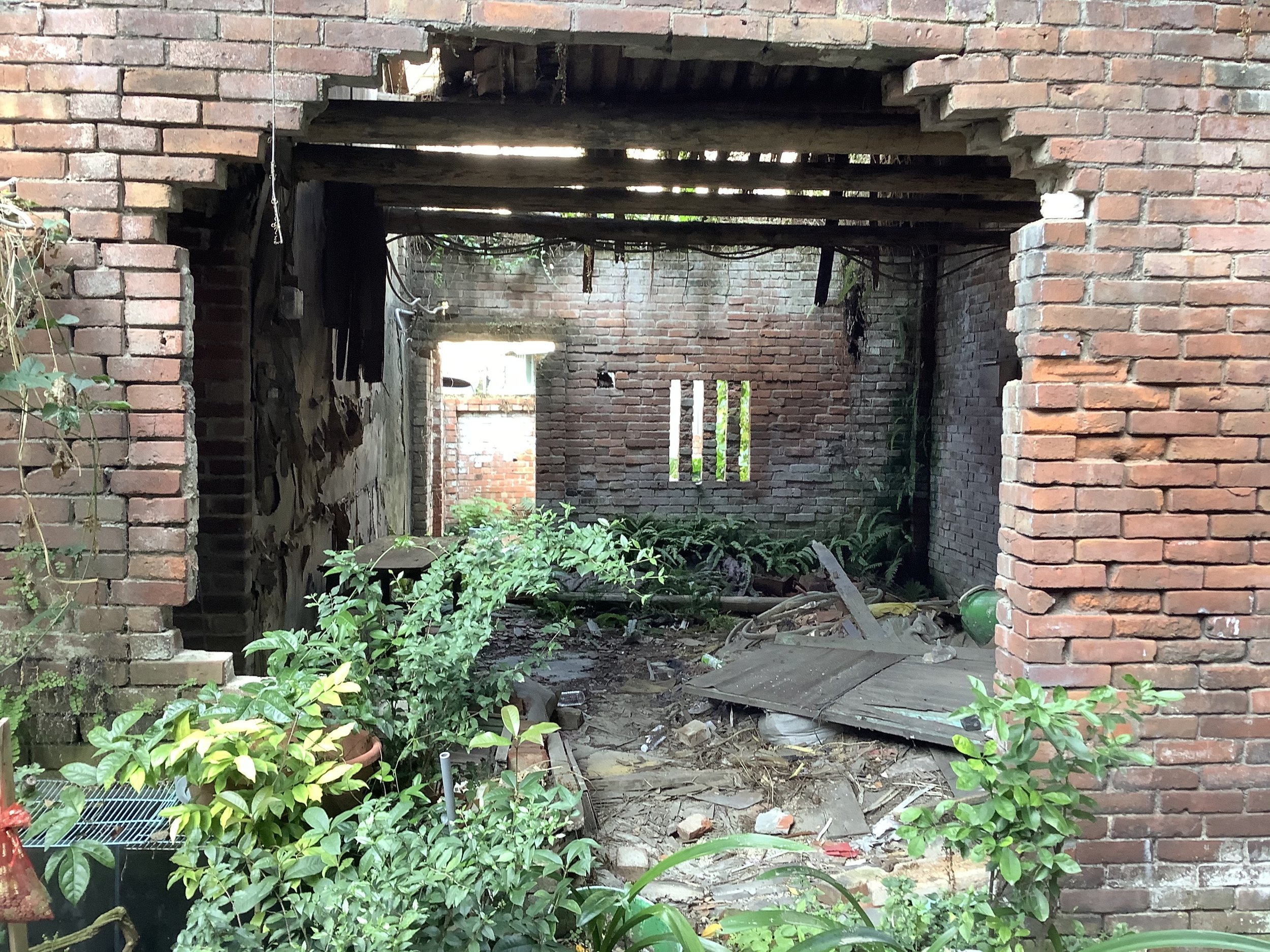
An abandoned, ruined house in Xinzhuang Old Street. Photo by Valentina Gamberi, contained in Haunting Ruins.
Valentina Gamberi, former MSCA-CZ fellow, Independent Researcher
Perspectives on Ruins in Taiwan
I realised how material traces and ruins play a central role in shaping embodied memories and affections while I conducted fieldwork among the residents of the district of Xinzhuang (New Taipei City) who were involved in local history groups or heritage classes. In a district like Xinzhuang—where ruins are incorporated into new buildings and abandoned Qing-dynasty houses coexist with skyscrapers—memories emerge from seeing and touching ruins and imagining former buildings by looking at traces on the ground (Gamberi 2025). Memories, mental images and sometimes even ritual reproductions of past experiences—as in the case of Sharon, a girl in her twenties who reproduced her childhood games while on a visit with me to her former elementary school—circulate among residents who have lived here for centuries. On each occasion they brought a different perspective shaped by their personal background but guided by a common need to feel rooted and welcomed. This feeling, which goes beyond, contradicts, or coexists with the official heritage policies adopted by the People’s Republic of China (ROC), led me to explore ruins through a comparative, anthropological lens.
Haunting Ruins: a Snapshot
Anthropologists and scholars in critical heritage studies have increasingly addressed the epistemological and ethical challenges triggered by ruins, their cognate traces, and the social effects of processes of ruination and decay (DeSilvey 2017; Joyce 2024; Jethro 2020; Napolitano 2015; Navaro-Yashin 2009; Stoler 2008). As material remnants, ruins are auratic absences of the past such as with a Synagogue destroyed during the Holocaust that left an unspoken void and spatial emptiness where it was once located (Joyce 2021). But ruins and traces also substantiate and reveal what is at stake in politics of memory, heritage processes, lived experiences of the past, and the general constitution of knowledge, historical knowledge in particular (Buchczyk et al. 2025).
The volume Haunting Ruins: Ethnographies of Ruination and Decay, which I co-edited with Chiara Calzana, focuses on ruins rather than traces to understand the role of materiality in triggering multitemporal experiences, on the one hand, and forms of heritagisation, on the other. What makes a ruin? In the Afterword, the anthropologist Francisco Martínez sets out some basic criteria. According to him, “there are a few ingredients that are required to ‘bake’ a good ruin: an interval of neglect, architectural monumentality, social magnetism, and an aura of decay” (Martínez 2025: 180). This temporal discontinuity “leads to a particular cultural and ecological experience” (Martínez 2025: 181). The ruins documented and analysed in the book, across case studies spanning four continents, all reflect features of the dynamics Martínez points to. As a whole, they reflect diverse processes of negotiating the past, as situated between individual experience and heritagisation, through the materiality of ruins.
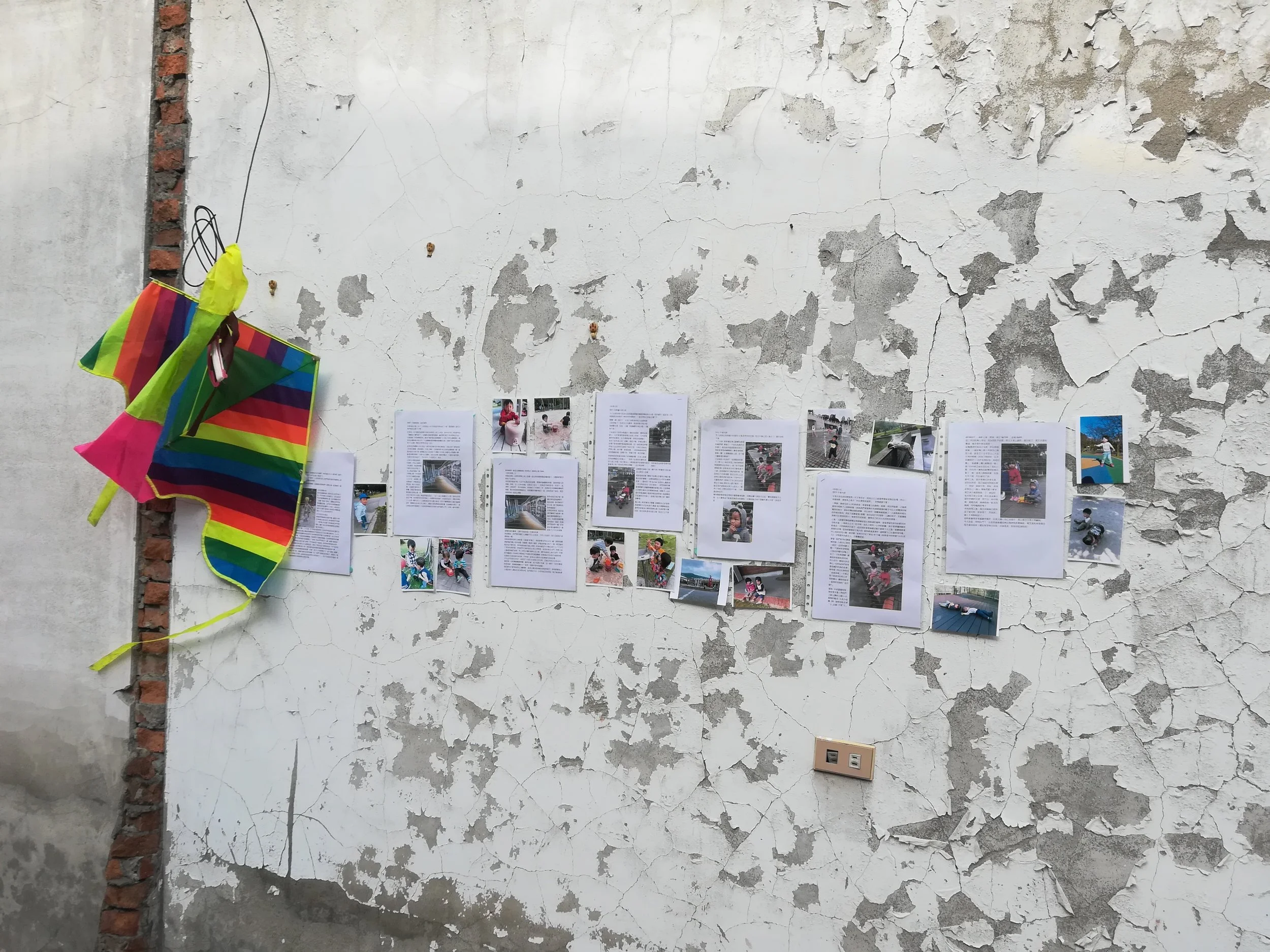
A wall of a demolished house in Xinzhuang Old Street, used by the oral history group of the Community University (Shequ Daxue) for a guided tour event. Photo by Valentina Gamberi, May 2019.
Our volume contributes to current debates about ruins, experience and heritage on methodological and theoretical levels. It stems from ruins and broadly reflects on the added value of ethnography in capturing lived experiences of the past, as compared to historiographical methods. The project takes its cue from Carlo Ginzburg’s (1993) micro-historical approach, in which he attempts to reconstruct the past through “proofs” or “traces” in archives, connecting large-scale historical events with individual biographies. Taking this position further, in our book we emphasise the importance of present embodiments of the past that are understood as “haunting,” a concept developed by Derrida (2012) and later reconceptualised by anthropologists working with spectrality and trauma (cfr. Espírito Santo 2023). Engagement with ruins allows the living past—detached in archival reconstructions — to be made present and inform memory and heritage practices (cfr. Sterling 2021). Using a multi-scalar approach — both macro- and micro-analysis — the chapters show how embodied resonance with ruins makes the past present. This past is a lived ontological quasi-reality that shifts according to the subjectivities involved (cfr. Corin 2020; Espírito Santo 2023), which are variably “haunted” by ruins: the significance of a specific ruin may differ for different social groups, especially if they face different levels of discrimination or privilege.
In our view, “haunting” is not necessarily linked to a traumatic past, although trauma makes it more disruptive. “Haunting” has a relational dimension that works through embodied resonance. This is effectively captured, we argue, through ethnographic methods in which the ethnographer’s long-term embodied experience or “impregnation” of their field site enables their understanding of the latter (Piasere 2002; cfr. Wikan 1992). All chapters of Haunting Ruins involve ethnographers actively walking among ruins with social actors they share life with during fieldwork (cfr. Edensor 2005). Walking is the research practice through which the double system of resonance — ethnographic observation and engagement with ruins — operates.
Although historians often consider resonating with past experiences as ahistorical, it is key to understanding and possibly also intervening in the politics of memory active in research contexts. Crucially, ruins reveal what has been silenced and erased by dominant memory narratives, showing how heritage practices always select narratives and ways of being to legitimise certain groups and their power over others. Ruins testify to how alternative stories, usually hidden (Larsen and Graezer 2025), can be disclosed and shared within and beyond the context of official heritage narratives. Engaging with multiple manifestations of the past through ruins during ethnographic practice should inspire action in the present and project future possibilities. It is thus a political project that contests authorised heritage narratives and rearticulates renewed forms of care (Buchczyk et al. 2025). This is the crucial role of anthropology and critical heritage at a time when capitalism and the Anthropocene are eroding existing forms of dwelling, leaving behind ruins (Tsing 2021).
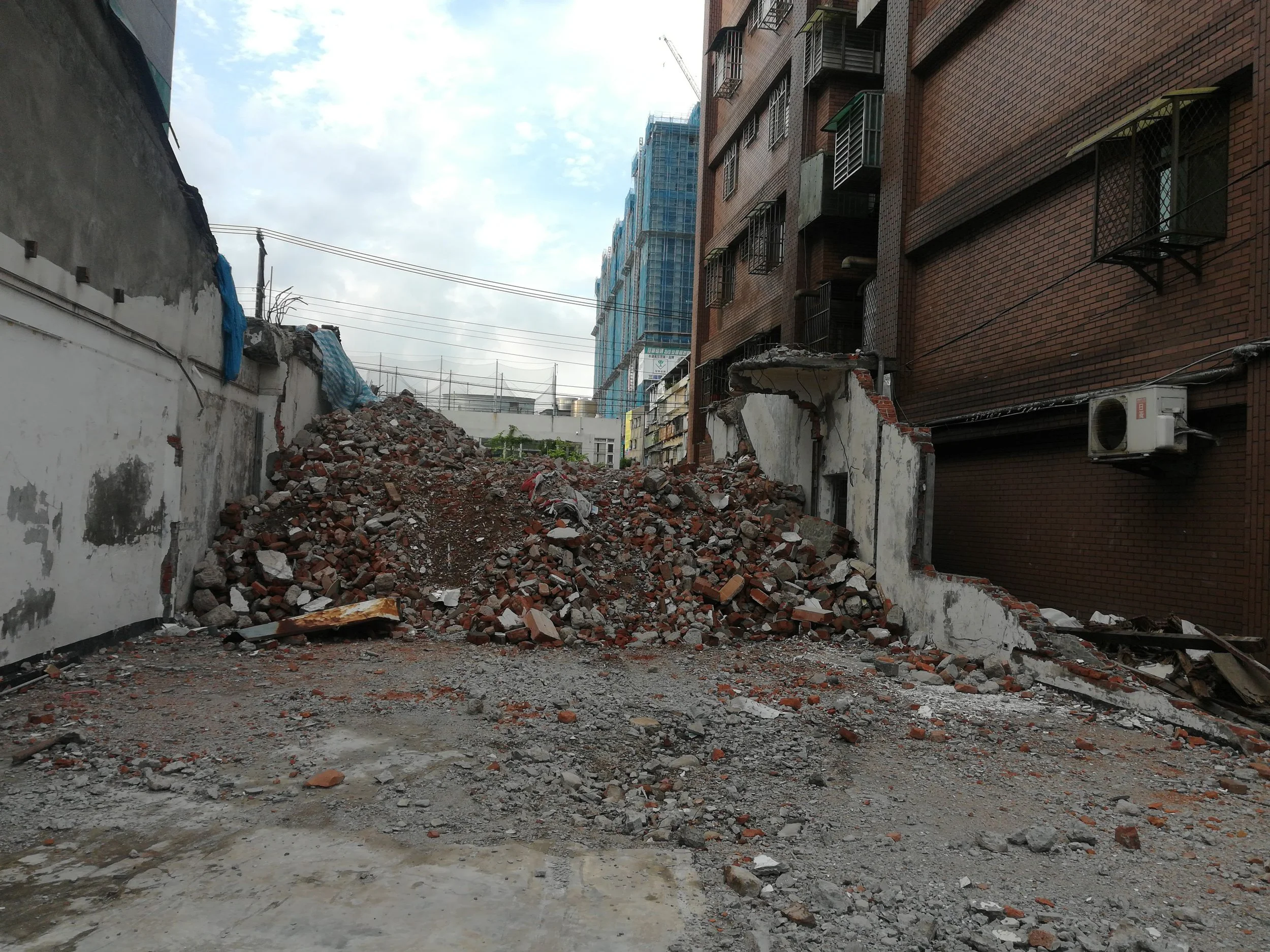
The demolished house as it appears on the front. Photo by Valentina Gamberi, September 2019.
Acknowledgments
The author warmly thanks her colleague, Dr Chiara Calzana, who read the first draft of this article and provided feedback on the parts related to their collective work Haunting Ruins.
References
Buchczyk, Magdalena, Martín Fonck, Tomás J. Usón, and Tina Palaić (Eds) 2025. Unearthing Collections Archives, time and ethics. London: UCL Press.
Corin, Ellen. 2020. “The Power of Traces,” Ethos 47(4): 440–450.
Derrida, Jacques. 2012. Specters of Marx: The State of the Debt, the Work of the Mourning and the New International. London: Routledge.
DeSilvey, Caitlin.2017. Curated Decay. Heritage Beyond Saving. Minneapolis: University of Minnesota Press.
Edensor, Tim.2016. “Walking Through Ruins,” in Tim Ingold and Jo Lee Vergunst (eds), Ways of Walking. Ethnography of Practice on Foot. London-New York: Routledge, pp. 123-141.
Espírito Santo, Diana. 2023. Spirited Histories. Technologies, Media, and Trauma in Paranormal Chile. London: Routledge.
Gamberi, Valentina.2025. “A Scattered Self: Composing Subjectivities through Ruined Houses (Taiwan),” In Haunting Ruins: Ethnographies of Ruination and Decay, edited by Valentina Gamberi and Chiara Calzana, pp. 71-92. Oxford New York: Berghahn Books.
Ginzburg, Carlo. 1993. “Microhistory: Two or Three Things That I Know About It,” Critical Inquiry, 20(1): 10-35.
Jethro, Duane.2020. Heritage Formation and the Senses in Post-Apartheid South Africa. London: Bloomsbury.
Joyce, Aimée.2021. “Silent Traces and Deserted Places: Materiality and Silence on Poland’s Eastern Border,” Ethnologia Polona, 42. https://doi.org/10.23858/ethp.2021.42.2714
Joyce, Aimée.2024. Spectral Borders: History, neighbourliness and discord on the Polish-Belarusian frontier. Canon Pyon: Sean Kingston Publishing.
Larsen, Peter Bille and Florence Graezer Bideau (Eds.) 2025. Hidden Heritage: narratives, politics, and agency. Roma: LetteraVentidue.
Martínez, Francisco.2025. “The Real Nation is Ruination,” In Haunting Ruins: Ethnographies of Ruination and Decay, edited by Valentina Gamberi and Chiara Calzana. Oxford New York: Berghahn Books, pp. 180-188.
Napolitano, Valentina. 2015. “Anthropology and Traces,” Anthropological Theory 15(1): 47-67.
Navaro-Yashin, Yael.2009. “Affective spaces, melancholic objects, ruination and the production of anthropological knowledge,” The Journal of the Royal Anthropological Institute 15: 1-18.
Piasere, Leonardo. 2002. The Imperfect Ethnographer. Experience and Cognition in Anthropology [in Italian]. Bari: Laterza.
Sterling, Colin. 2021. “Becoming hauntologists: A new model for critical-creative heritage practice,” Heritage & Society, 14(1): 67-86.
Stoler, Ann Laura. 2008. “Imperial Debris: Reflections on Ruins and Ruination,” Cultural Anthropology 23(2): 191-219.
Wikan, Unni. 1992. “Beyond the Words: The Power of Resonance,” American Ethnologist 19(3): 460-482.
Tsing, Anna Lowenhaupt. 2021. The Mushroom at the End of the World: On the Possibility of Life in Capitalist Ruins. Princeton Oxford: Oxford University Press.
Valentina Gamberi was a MSCA-CZ fellow at Palacký University (UPOL) until February 2026. Previously, she held positions as Adjunct Lecturer (University of Bologna, 2022–2023) and Research Fellow (Research Centre for Material Culture in Leiden, 2021–2022 and the Department of Ethnology of Academia Sinica, 2019–2020). Her main research fields are material culture studies, museum anthropology, critical heritage and religious studies. She is the author of Experiencing Materiality: Museum Perspectives (Berghahn Books, 2021).